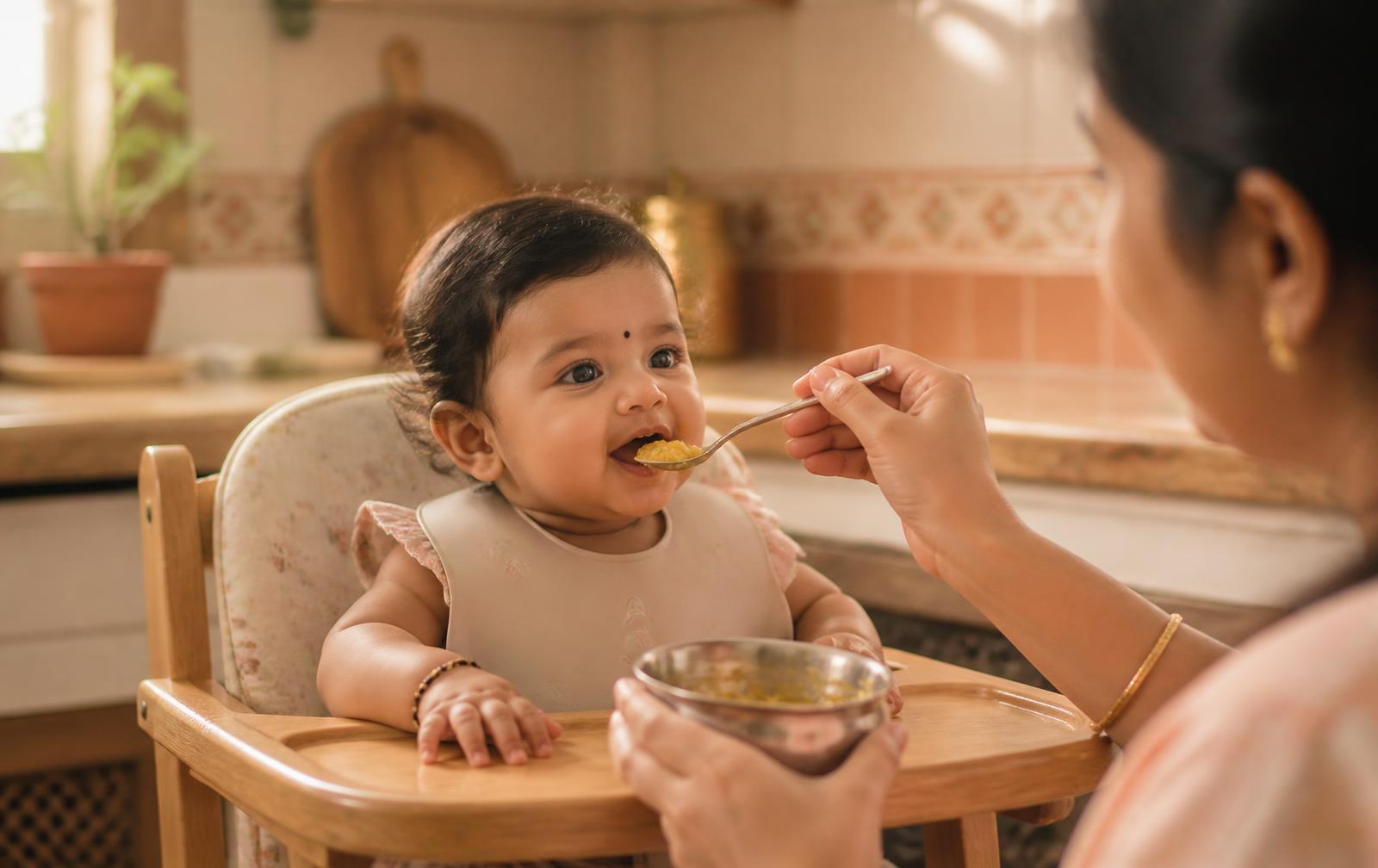
First Foods: starting your baby on solids
A calm, complete guide to starting your baby on solids — what to give first, what to skip, and what your grandmother got exactly right.
Infant (6–12 months)~8 min readFree
Keep this one. Download the printable PDF.
Stick it on the fridge, or forward it to the family group — the whole guide, in one calm printable.
Somewhere around the five- or six-month mark, your baby starts watching you eat. Really watching — tracking the roti from your plate to your mouth like it is the most fascinating thing in the world, maybe even lunging for it. It is one of the loveliest milestones of the first year. It is also the one that sends the most parents into a quiet spiral.
Because everyone has an opinion. Your mother says start early. The internet says purée everything. Your paediatrician says one thing, the aunty in the lift says another, and a well-meaning WhatsApp forward says something that mildly terrifies you.
Take a breath. Starting solids is genuinely one of the more forgiving parts of parenting. There is a wide range of "right," your baby is a more capable eater than you think, and almost nothing you do in these first weeks is a mistake you cannot gently correct.
This guide is the calm, complete version — built on current guidance from the WHO, the AAP and the NHS and the latest allergy research, then translated back into a real Indian kitchen. Keep it, come back to it, and go one bite at a time.
1. When to start: watch your baby, not the calendar
The short answer is around six months. The better answer is: when your baby shows you they are ready. Readiness is about development, not a date — some babies are set a little before six months, some a couple of weeks after, and both are completely normal.
Here is what "ready" actually looks like:
If your baby is six months old but not quite showing these signs, it is fine to wait a week or two. And one piece of advice to gently retire: the old "start rice cereal at four months." Current guidance is clear that before four months is too early, and for most babies six months is the mark. Starting sooner just puts pressure on a system that is not ready.
One reassuring thing to hold onto: at the start, solids are practice, not dinner. Your breast milk or formula is still your baby's main nutrition for a while yet. These first weeks are about learning — taste, texture, and the strange new business of moving food to the back of the mouth and swallowing.
2. The one thing that actually matters: iron
If you remember only one nutritional fact from this whole guide, make it this one. Babies are born with a store of iron that carries them through roughly the first six months. Right around the time solids begin, that store starts running low — and iron matters enormously for your baby's fast-growing brain.
So the quiet goal of early solids is not variety for its own sake. It is simply this: include at least one iron-rich food every day.
The good news is your kitchen is full of them:
A note for the grandmothers reading over your shoulder: this is one place tradition and science shake hands. Ragi and dal were not chosen by accident.
3. What to give first: your kitchen is already stocked
You do not need jars, pouches, or a single imported thing. Some of the best first foods in the world are already in your kitchen. Start with smooth, single-ingredient foods:
| First food | Why it is a great start | How to prepare it |
|---|---|---|
| Thin moong dal khichdi | Gentle, easily digestible, iron-rich | Cook soft, blend or mash smooth, thin with water or milk |
| Mashed ripe banana | Naturally sweet, no cooking needed | Simply mash a ripe banana with a fork |
| Mashed boiled vegetables | Sweet potato, carrot, lauki — soft and mild | Steam or boil until very soft, then mash smooth |
| A little ghee | Healthy fat for brain development | Stir a small amount into khichdi or veg |
| Mashed cooked fruit | Papaya, pear, apple — easy and sweet | Cook apple or pear soft; ripe papaya can be mashed raw |
Texture at the very start: think smooth and slightly runny, loosened with your baby's usual milk or a little cooled boiled water. You will thicken it and add soft lumps over the coming weeks as they get the hang of it.
4. One new food at a time: the three-day rule
When you introduce a new single food, give it for about three to five days before adding the next new thing. If your baby reacts to something, this simple rhythm makes it easy to spot the culprit. Once a food has been happily tolerated, it joins the "safe" list and you can start mixing freely — dal with veg, khichdi with a swirl of ghee, banana with a little yogurt.
This is not about being rigid. It is just a gentle, sensible way to get to know how your baby responds.
5. Allergens: the biggest change from your mother's day
Read this section carefully, because the advice has completely reversed in the last decade — and a lot of well-meaning family wisdom is now out of date.
For years, parents were told to delay allergenic foods — peanut, egg and the rest — until age two or three. We now know that was wrong, and may even have made allergies more common. A landmark study known as LEAP found that introducing peanut early, and keeping it in the diet, reduced peanut allergy by around 80%. The guidance today is clear: introduce common allergens early — from around six months, once your baby is on solids — not before four months, and for all babies, not just "high-risk" ones.
Here is how to do it calmly and safely:
The two to start with: peanut and egg
Peanut: never whole nuts or a spoonful of thick peanut butter — both are choking hazards. Instead, stir a small amount of smooth peanut butter (or peanut powder) into warm dal, khichdi or fruit purée until it is thin and lump-free.
Egg: well cooked. A well-cooked, mashed egg is perfect.
The common allergens to make sure your baby meets during the first year include peanut, egg, cow's milk (as yogurt, cheese or in cooking — not yet as a main drink), tree nuts (as smooth butters or powder), soy, wheat, sesame (til — very relevant in Indian kitchens), and fish and shellfish.
6. Spices: your grandmother was largely right
Here is where Indian babies have a genuine advantage — a world of gentle flavour that bland "baby food" never offers. And most of it is absolutely fine early.
| Spice | When | How to use it |
|---|---|---|
| Haldi, jeera, dhania, saunf (turmeric, cumin, coriander, fennel) | From ~6 months | A small pinch, cooked into dal or khichdi |
| Cinnamon, cardamom (dalchini, elaichi) | From ~6 months | Tiny amounts, for warmth and aroma |
| Hing (asafoetida) | Topically on the tummy earlier; a tiny pinch cooked in from ~8–9 months | Aids digestion — use sparingly |
| Chili, lots of black pepper, garam masala, added salt, added sugar | Hold until after the first birthday | Baby kidneys and taste buds do not need these yet |
The principle is simple: gentle, aromatic spices yes; heat, salt and sugar no. Your baby can absolutely eat like a (mild) member of the family.
7. What to absolutely avoid in the first year
8. Choking vs gagging: please read this twice
This is the fear that keeps parents up at night, so let us be clear and calm about it — because the single most useful thing you can do is learn the difference between the two.
| Gagging — normal and expected | Choking — an emergency |
|---|---|
| Loud. Coughing, spluttering, a red face, watery eyes. | Silent. No sound, no cry, no cough — the airway is blocked. |
| It is your baby's built-in safety reflex pushing food forward and out. | You may see panic, colour draining, or the chest working with no air moving. |
| What to do: stay calm, keep your hands out of their mouth, let them sort it out. It gets less frequent with practice. | What to do: act immediately and call for help. Do not finger-sweep, which can push food deeper. |
In the early weeks a baby's gag reflex sits far forward on the tongue, which is exactly why they gag easily and often. The best insurance is a short infant first-aid / CPR class — many are free, and knowing what to do turns fear into readiness. Do it before you start solids if you can.
9. Purées or finger foods? Neither is "better"
You will hear two camps: traditional spoon-fed purées, and "baby-led weaning" — offering soft finger foods your baby feeds themselves from the start. The honest truth is that neither is superior, and most families happily do a mix: a loaded spoon of dal here, a soft strip of steamed sweet potato to gnaw on there. A large trial found that baby-led weaning, done with proper attention to safe shapes and hazard foods, is no riskier than spoon-feeding.
So choose what suits your baby and your nerves. And if the whole idea of finger foods makes your heart race — that is not a flaw, it is love. Prepare safely, supervise closely, and let confidence build one meal at a time.
10. How much, how often: finding the rhythm
Start small and unhurried: once a day, a few teaspoons, at a time when your baby is happy and alert rather than ravenous — a screaming-hungry baby has no patience for a spoon. Over the following weeks and months, you will build toward two and then three small meals a day.
| Age | What it looks like | The rhythm |
|---|---|---|
| ~6–7 months | Milk is still the main event | 1 meal a day, a few teaspoons, building slowly. One iron-rich food daily. |
| ~8–9 months | Solids becoming real | 2 meals a day; thicker textures and soft lumps; introduce soft finger foods. |
| ~10–12 months | Three small meals + snacks | Mild versions of family food; more variety and texture. |
Let your baby lead the amount. If they turn away, close their mouth, or lose interest, they are done — please do not chase the last spoon. Forcing rarely works and can sour the whole experience. Some days they eat with gusto, some days barely anything. That is normal. Trust the pattern over weeks, not the drama of a single meal.
You may hear "food before one is just for fun." There is truth in it — milk is still doing the heavy nutritional lifting — with the one asterisk you already know: iron.
When to check with your paediatrician
One last, warm word
Starting solids can feel like a test you did not study for. It is not. It is a slow, joyful, occasionally messy unfolding — and your baby has been getting ready for it their whole short life. Some meals will end up more on the floor than in the baby. Some will be pure magic. Both count.
Go gently. Follow your baby. Keep the good parts of what your mother taught you, update the few that have changed, and remember you are not doing any of this alone. One bite at a time.
— Team BuddingWonders
Keep this one. Download the printable PDF.
Stick it on the fridge, or forward it to the family group — the whole guide, in one calm printable.
BuddingWonders — personal guidance for Indian parents, at home and abroad. This guide is general information to help you feel prepared and is not a substitute for personalised medical advice.
Note. This content is for general educational purposes only and is not a substitute for personalised medical advice. Always consult your own doctor about anything specific to you or your child. Read our full Disclaimer.
More guides
The Baby Sleep Guide
Nights, naps and the whole honest picture — without the sleep-training shouting match.
The Feeding Guide: breast, bottle & combi
Latch, supply, formula, mixed feeding — all of it, judgement-free.